
8
Owned the outcomes
Co-founder and CEO of Sentry Enterprises, a deep technology startup spanning biometric identity and payment card technology.
I'm a fractional Chief AI Officer. I work as a part-time fully embedded leader for small-to-mid-market companies that want AI to be a reliable part of how work gets done rather than an expensive novelty.

My fractional CAIO experience rests on real operator scar tissue, not just reading about it.
Co-founder and CEO of Sentry Enterprises, a deep technology startup spanning biometric identity and payment card technology.
Sentry Enterprises valuation increased more than tenfold while building IP and strategic partnerships across payments and digital identity.
Global technology operations at Chicago Mercantile Exchange across Belfast, Singapore, India, Argentina, Chicago, and London.
Built CME's Belfast international captive center and led approximately 250 employees and consultants across Europe and Asia technology operations.
“Highly strategic, technically adept, and mission-driven leader. Ability to bridge technology and business strategy, coupled with steady leadership through periods of rapid change.”
Most companies I see have at least two of these going on:
Every function picked its own AI tool. The subscriptions add up. Actual workflow value is uneven and rarely measured.
One or two people do impressive AI work. Everyone else copies the surface and misses the judgment that makes it work.
Promising experiments stall before they become how the company actually operates.
Different people on the same leadership team have different answers for what AI should be doing here.
A fractional is a part-time fully embedded leader. The only difference between a fractional and their full-time counterpart is that they are part-time.
When I take a retainer engagement, I am in the seat. I sit in leadership team meetings. I participate in real decisions. I am accountable for outcomes alongside the existing leadership team. I am not a vendor or an external advisor. I am a part-time CAIO.
Small-to-mid-market companies often cannot justify a full-time Chief AI Officer at the salary that role commands. They also cannot afford to keep treating AI as a side initiative that no senior leader actually owns. The fractional model fits that gap.
Engagements typically unfold across three phases.
A focused engagement to take a deep dive into your company and your workflows. Output is a feasibility-validated roadmap for where AI fits in the business. Roughly 30 days, scoped to your situation.
Drive the first wave of redesign. A bounded engagement to execute the highest-priority moves from the roadmap, proving the model before any commitment to ongoing leadership. Roughly 60-90 days.
The ongoing engagement to embed AI into how the company runs. A few hours per week in your leadership team, accountable for outcomes alongside the existing team. Weekly working session, monthly written summary, quarterly review.
A 90-minute paid working session, one-to-one with me. Ends with a written brief on where your AI work should focus over the next 90 days. The way to get a clear-eyed read before committing to a longer engagement.
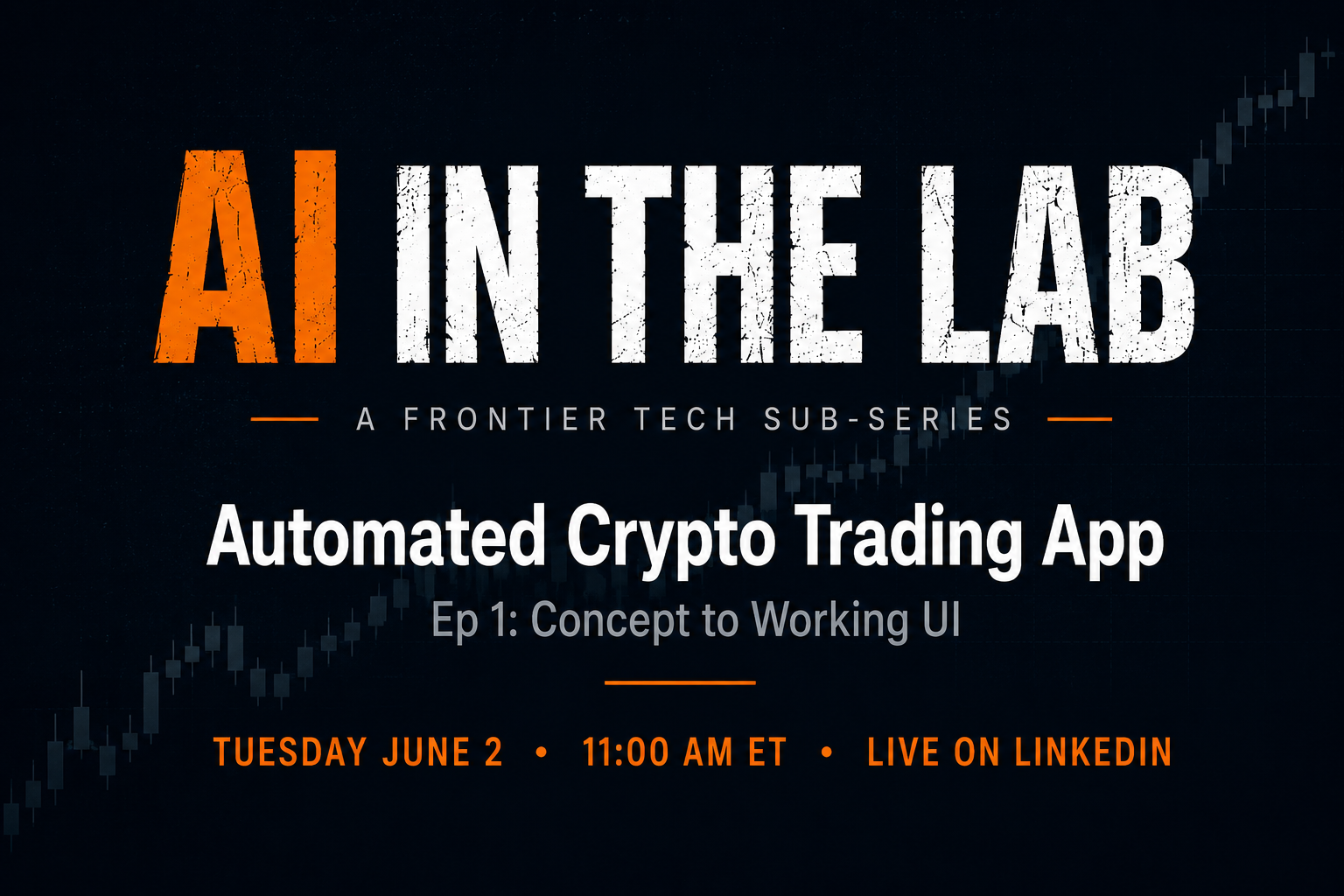
Frontier technology for the people building real companies. Latest episode: AI in the Lab Episode 1, building an automated crypto trading app with AI as a partner. Recording now on YouTube.
Licenses purchased and tools opened are not the same as work being done differently. Compute is the cheapest part of the stack and the easiest line item to cut when leadership looks for ROI.
Better prompts cannot save a workflow that was never designed for AI involvement. The work has two layers. Redesign workflows around what AI makes possible. Level up the people doing the work so they move past chatbot-grade use.
If the direction is wrong, more speed makes things worse. If the leadership team is not aligned on what AI should accomplish, no tool deployment can fix that.
They are data, workflow or ownership problems. Outdated data produces wrong recommendations. Undefined workflows resist automation. Unclear ownership produces motion without accountability.
A consultant who hands over a deck and leaves has no skin in whether the recommendations work. A fractional executive who sits in the leadership team week to week is accountable for outcomes alongside the existing team.
AI did not change that. It just made it cheaper to ignore. The companies that succeed treat verification and judgment as core engineering work, not as polish.
Book a 30-minute scoping call to see whether a fractional engagement fits. Or take the deeper paid Strategy Session if you want a written brief on where your AI work should focus.
Learn about AdviceForge with AI
Get an independent summary from the AI tools you already use. Always verify details on this site.
 Ask ChatGPT
 Ask Perplexity